

What is Usenet? Question about Usenet.
What is Usenet? Usenet can be defined as a network where people exchange news. It is used for several purposes by people and support groups for sharing information. Its’ main purpose is to offer a network where users can post information freely, which is then distributed. This allows others to access the information easily and as quickly as possible.
Usenet is regarded as one of the oldest networks. In fact, it was conceived in 1979. This means that it was implemented before the World Wide Web. The fact that it is a distributed network means it is not controlled by any single source. It also means that it remains largely uncensored. In order to access Usenet Newsgroups you will need Best Usenet Provider. We have done the research for you so it is easy to get started
Usenet was created by two graduate students of Duke University in North Carolina, Jim Ellis and Tom Truscott worked on their idea of connecting different computers to exchange information within the UNIX community, and thus created a network that allowed the exchange of information and served as a bulletin-board.
It began as a small, restricted communication network between some of the universities in the United States. It was used for news, trade information and research results. Over the last 3 decades, Usenet has evolved considerably and has grown from a simple restricted communication network to a well-structured logical network connecting hundreds of millions of people and computers to 100,000 and more newsgroups and millions of articles.
Usenet became popular in university campuses and early Usenet users enjoyed discussing a broad range of ideas with fellow students and discussed Politics, Technology, Science, Philosophy, Music, Science Fiction and much more. Students from the universities would meet in various newsgroups via their computers and freely voice their opinions, seek advice, consultation, and also interact with other users from different universities who shared the same interests.
For many years, Usenet was mainly accessed by university students and faculty and tech-savvy home users just like the internet itself. It provided forums or what they call newsgroups to discuss several topics that are of interest to users. Just like message boards, newsgroup users post messages or articles as they are known for other users to read.
The fact that there are thousands of such newsgroups, it means you are likely to access nearly any topic you can think about. Some newsgroups have individuals who act as administrators and moderators. They ensure that content posted is relevant to the newsgroup topics and eliminate inflammatory content.
What is Usenet Today
Today, Usenet is a frequently updated collection of user-submitted notes / messages on a variety of subjects that are posted frequently to servers on a worldwide network. Each of these collections comprising of posted notes is called a newsgroup. There are hundreds of thousands of newsgroups on the server and it is possible for any user to create a new one. Most of these newsgroups are hosted on servers that are connected to the Internet, but these newsgroups can also be hosted from servers that are not connected to the Internet. Usenet continues to be an unrestricted, worldwide forum for debate and information exchange.
As new advancements continue to shape the internet world and challenge usenet as a way of communication, its popularity continues to increase. People require peer-moderated, uncensored communication, which will keep usenet alive long into the future.
Usenet’s original protocol in the early 1980’s was UNIX-to-UNIX Copy (UUCP), but today it’s protocol is Network News Transfer Protocol (NNTP). So this is Usenet.
What is a Newsgroup?
A newsgroup is an active online discussion forum that is easily accessible through Usenet. Each newsgroup on the server contains discussions about some specific topic, which is often indicated in the name or title of the newsgroup. Users who are looking for a particular newsgroup can browse and follow them. Users can also post or reply to the topics they are interested in, using a newsreader software. We can help you pick your Newsreader with our Which Newsreader should you use? Access to these newsgroups also requires a Usenet subscription. Most of the Usenet Providers have monthly subscription for $10 USD a month. These are our choices of Best Usenet Providers.
A newsgroups can be either moderated or unmoderated. In moderated newsgroups, all posts must be approved by a moderator first if the user wants to become a part of the discussion. In unmoderated group, there is no restriction of any sort, and everything posted by users becomes part of the discussion. Some of the newsgroups also use bots to moderate the content. These bots can automatically eliminate posts that are deemed as offensive or off topic.
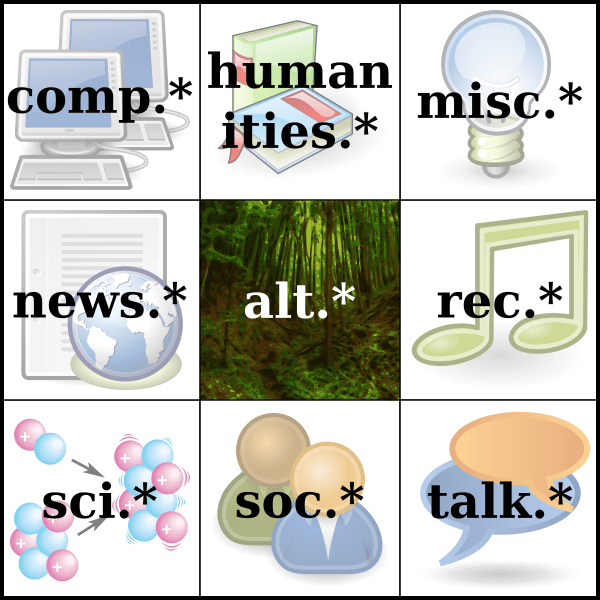
Below are a few examples of active online newsgroups. The first part that is before the first dot tells users about the primary category or the newsgroup.
- politics
- binaries.multimedia.comedy
- religion
- software.testing
- physics
- binaries.documentaries
Subscribing to Newsgroups
 Joining and subscribing to a newsgroups on Usenet may sound complicated to some but it’s quite simple and much more secure than other online discussion platforms on the Internet. In Usenet, it is quite easy to keep your anonymity.
Anyone can join in and once you are part of the newsgroup, you are connected to the Usenet provider’s server and can easily select the newsgroups that you wish to subscribe to with just a click on the “Subscribe” button of your newsreader. When you join the newsgroups, you can visit and post whenever you want or read the content that is recently shared.
How to Get Started with Usenet
In order to get started with Usenet, you will need four things:
- A reliable Usenet Provider Subscription-Best Usenet Service Provider 2024
- A Usenet Search Engine / An Indexer Best Usenet Search Engines Site 2024
- A Newsreader – Best Newsreader 2024
- A NZB –Best NZB Sites 2024
In most cases, the Usenet Service Provider may offer subscribers all four of these services in a single package, or you may have to use third party software.
Best Usenet Providers And Their Features
Discover with our choice of Best Usenet Providers. These Usenet Services are the most popular and well-established Usenet Providers in the market today.
- UsenetServer is the most popular Usenet provider , offering users faster speed and longer retention period. But the number of newsgroups is comparatively low, around 80,000. It is preferred by majority of intermediate users.
- Newshosting is without doubt the most efficient of all Usenet Provider. It offers great value for money with fast speed, reliable service, a free newsgroup browser, as well as, a large number of newsgroups (100,000). It also offers classic NNTP access / a modern web-based newsreader option. Users can also avail a free trial account of 30 GB for the first 14 days.
- EasyNews is considered to be the best web browser for Usenet and one that is ideal for beginners. It has a web-based interface that enables thumbnail viewing for people who are interested in searching with images and video binaries. This newsreader a large user base and offers the best customer service.
- Eweka is a Usenet provider which offers Usenet access in both block and flat rate payment options. It’s affordable and a wise choice for the tech-savvy. There are Usenet providers all over the world. Eweka – the company is based in the Netherlands, and it’s an affordable Usenet service that put quality as their prime goal.
- FastUsenet offers excellent retention rates, a free trial, a mobile friendly newsreader and a web newsreader as part of their core package. Fast Usenet also comes with a free copy of GrabIt newsreader, offering built in global search which normally costs $2.50 a month. Included with your membership
- Giganews is another great Usenet provider but is comparative most expensive and slickest of all providers. It offers a good customer service and comes with a free bundled newsgroup browser, known as, Mimo. It also has the largest number of newsgroups (110,000). and offers a free trial of 10 GB to new users.
Usenet Search Engine Sites? How do I search Usenet?
Usenet search engine work something like Google but they specifically search newsgroups. They are constantly indexing Usenet groups for the latest content. UsenetServer Global Search gives you full access to newsgroups. This includes the ability to search for content, preview, and download. All from within the software interface. The built-in search engine will help you find the best that Usenet has to offer. It will also auto repair and extract your downloads.
A USENET SEARCH ENGINE is a service that searches through Usenet newsgroups to find specific content. Usenet search engines can be used to search for anything, but they are most often used to search for binary files. For example, you might search for photos of a famous person or a car you have been looking for. You can find out more at What is a Binary Files? Usenet Binaries Explained.
Usenet search engines look for what you want by searching through all the header lines in a particular set of newsgroups. There are so many newsgroups to search, you need to specify which newsgroups you want to search. It is important to understand that the output of a Usenet search engine is information about the articles that meet your criteria, not the actual articles themselves. Once the search is complete, this information can be saved in what is called an NZB FILE, a text file that stores information using XML. (XML is a general-purpose specification used to transport and store data.)
Once you have an NZB file, you can download it and open it with your newsreader. Your newsreader will then connect to your news server and download all the articles specified in the NZB file.
This is particular useful when you are looking for binaries that may have tens, hundreds, or even thousands of parts. The NZB file will contain all the information your newsreader needs to download all the parts. Once they arrive, your newsreader will put them together for you automatically to recreate the original file.
What is a Newsreader?
A Newsreader serves as Usenet’s very own web browser. A newsreader allows users to search and view different newsgroups and articles. There are a variety of Usenet newsreaders today that come with multiple capabilities and features that are much more capable than an ordinary web browser. All newsreaders specialize in downloading a variety of files. There are also a few newsreaders that require a subscription.
How Do I Choose A Newsreader?
There are two main types of newsreaders, one is the traditional newsreader that allows users to send and receive messages. These messages are then distributed to everyone who follows that particular newsgroup. These newsreaders usually focus on text. Users can access binaries in a few cases, but the focus is mainly on newsgroup discussions. These newsreaders encourage users to invest their time in reading articles, getting to know other newsgroups, commenting, and other related activities. When a user follows a newsgroup, new articles and debates automatically upload in his / her newsreader when they are signed in.
The other type of newsreader is the NZB Newsreader that only function with NZB files. Users cannot read articles or exchange posts / messages on this newsreader. NZB files put all of binary pieces into a machine-readable markup language (XML). An NZB Newsreaders supports NZBs and automatically download those messages. This type of newsreaders completely eliminates the need to browse different newsgroups and also eliminate the need to search threads or individual messages. The best thing about these newsreaders is that they make finding binaries extremely easy. Users can easily locate the NZBs they need without having to interact with other users. Making the search and download process a piece of cake.
Usenet.com Review Recommended Newsreaders
What makes a newsreader good is it’s ability to navigate and explore required content and communities available on the Usenet newsgroup servers. Newsreader software works like an email client, making it easy for users to browse content and messages from different newsgroups. It also allows them to bookmark / subscribe to those newsgroups that are of interest to them.
Majority of the newsreaders today are binary capable, which means they come with download, reassemble and decode functionality for user generated binary files, like ISO CD images and much more. They save users a lot of time. The high-speed and global access of newsreaders is what makes Usenet the perfect place to share, upload and download user-generated files and content. What is Usenet
Usenet.com Review Best Newsreaders 2024 recommendations include the following:
What is an NZB?
NZBs have an XML-based format, XML stands for Extensible Markup Language. This language encodes documents in a way that makes them readable to both humans, as well as, machines. NZBs are plain text files that can be easily viewed with a word processor. They usually look like an HTML page where the text is specifically formatted to be read by an application or a program.
NZB makes downloading big binaries extremely easy. It allows a newsreader to quickly search for all the different parts of a single binary and gather those parts in the right order. The launch of NZB changed Usenet forever. Today, all newsreaders specialize in NZBs. If a users wants to download binaries, NZBs are their first choice.
Best NZB Sites
On the Usenet, NZB files are equivalent to a small text file that quickly points to the media a user wants. You can read about it at What is a NZB? The popularity of NZB files has increased over the years. There are numerous search engines that provide fresh and latest NZB files. The top 4 NZB sites are:
EasyNews:
NZBPlanet: It has open registration and is very comprehensive. The only limitation is that a user can only download 10 NZBs in a single day.
GingaDaddy: It has open registration and a good index. One annoying feature is the captcha.
NZB-Tortuga: It has open registration and has a fully featured index.
Now that we have explained. What is Usenet? Answered your Question About Usenet. What you need to get started Best Usenet Service Provider, Usenet Search Engine, Newsreader, NZB. You should now know How to use Usenet. Begin with a Free Usenet Trial.